
The most read Vietnamese newspaper
Edition: International | Vietnamese
© Copyright 1997 VnExpress.net. All rights reserved.
 Get VnExpress first in Google Search
 See more of the news you trust. Make VnExpress a preferred source to prioritise our updates in your Google search results
The experiment used Nighthawk r2, IBM's latest quantum processor, and was led by Tigran Sedrakyan, a theoretical physicist at U.S.-based quantum computing company BlueQubit, according to science news outlet ScienceAlert.
The results were published Sept. 23 on arXiv, an online repository for scientific research papers. The study has not yet been peer-reviewed.
Nighthawk r2 has 120 qubits, the quantum equivalent of the bits used to store and process information in conventional computers, according to IBM. The processor can be accessed commercially through the company's cloud platform.
For the experiment, the researchers used 61 qubits and put them through increasingly complex operations. The processor generated one million results in just 19 seconds, according to the study.
The test used a method known as random-circuit sampling, in which quantum computers perform increasingly complex calculations that become extremely difficult for conventional computers to reproduce.
Based on the performance of Frontier, one of the world's fastest until supercomputer in the U.S., the researchers estimated that reproducing the result using conventional computing methods would take about 110 years.
 |
|
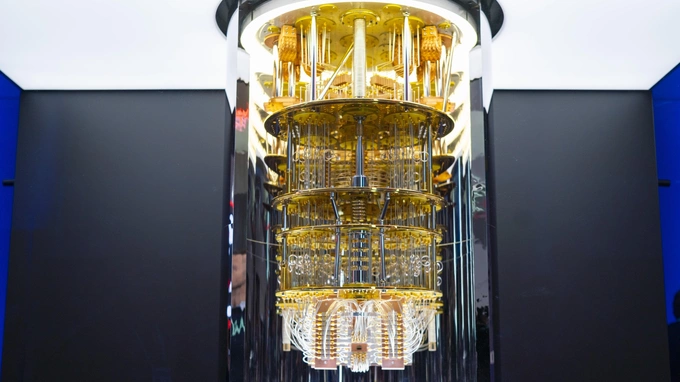
The IBM Q quantum computer at CES 2020. Photo courtesy of IBM |
The figure is an estimate based on a particular method of reproducing the quantum experiment on a conventional computer, rather than an actual test on Frontier, and more efficient algorithms could significantly reduce the estimated time.
Sedrakyan and his colleagues said their experiment was the first demonstration of quantum advantage in this type of test using a commercially accessible quantum processor.
The researchers conducted the experiment through IBM's standard cloud service without specially adjusting the machine for the test. They do not claim that conventional computers could never match Nighthawk r2, but say the experiment shows how far commercially accessible quantum computing has progressed.
The experiment is the latest attempt to demonstrate "quantum advantage," when a quantum computer performs a specific task that would be extremely difficult or time-consuming for even the most powerful conventional machines.
Random-circuit sampling has been used for years as a benchmark in the race to achieve quantum advantage.
In 2019, Google said its 53-qubit Sycamore processor completed such a task in about 200 seconds, while estimating that a leading supercomputer would take about 10,000 years, according to a study published in Nature.
Researchers later developed more efficient conventional computing methods that dramatically narrowed that gap, showing how estimates of quantum advantage can change as classical computing techniques improve.




